
A business internet contract can look straightforward: choose a speed, agree a monthly price and sign. In practice, the detail behind those figures can affect productivity, customer service and operating costs for years.
The cheapest quotation is not always the best value, while the fastest advertised download speed may not solve the problems your team faces. Upload capacity, fault response, installation risks, price increases and backup connectivity can matter just as much.
This checklist is for business owners, office managers and IT leads comparing providers. Ask every supplier the same ten questions, request the answers in writing and compare the complete service rather than the promotional price.
Before You Start: Define What the Business Needs
Note how many people and devices use the connection, which cloud systems are essential, how many simultaneous video or VoIP calls you expect, and what one hour of downtime would cost. Digital Exchange’s guide to choosing the right business internet speed can help you set a realistic requirement.
Confirm which services are available at each location. The Ofcom Mobile and Broadband Checker provides an independent starting point, although a provider may still need a detailed availability check or site survey.
1. What Exactly Is Included in the Quotation?
Ask for a written description of the connection, router or firewall, installation, support, static IP addresses and managed services. Make sure the quotation identifies anything that costs extra.
The contract should explain what the provider is responsible for and where that responsibility ends. Broadband may be working correctly while poor internal Wi-Fi, old cabling or an overloaded network causes problems inside the office.
Compare total cost across the full term, including setup, equipment rental, delivery and out-of-bundle support. Our business broadband costs guide explains why the headline monthly price may not reflect the final bill.
2. What Download and Upload Speeds Should We Expect?
Ask for estimated or guaranteed download and upload performance, including expected busy-period speeds. Upload capacity matters for cloud backups, large file transfers, video meetings and VoIP telephone systems.
Where the provider follows Ofcom’s voluntary Business Broadband Speeds Code of Practice, it should supply relevant speed information before purchase and in writing after the sale. Ask whether the proposed product is covered and what remedy applies if performance remains below the stated minimum.
3. What Technology Will Deliver the Connection?
Terms such as fibre, full fibre and Ethernet are sometimes used too loosely. Ask whether the service is FTTP, copper-based broadband, fixed wireless or a dedicated fibre leased line, and confirm how the final connection reaches your building.
FTTP runs fibre to the premises but is normally shared. A leased line reserves dedicated bandwidth and usually provides symmetrical speeds and stronger service commitments. Our guide comparing business broadband and leased lines explains when the additional resilience may be justified.
4. What Does the Service Level Agreement Actually Guarantee?
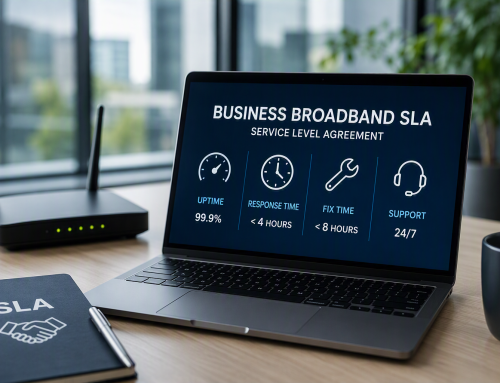
An SLA should contain measurable commitments, not phrases such as ‘business-grade support’. Ask what uptime, response and restoration targets apply, when the clock starts, which faults are excluded and what credit is available if the provider misses a target.
Do not confuse a response target with a guaranteed fix time. A provider may acknowledge a fault quickly but take much longer to restore service. Compare the SLA with the likely cost of downtime and whether a leased line’s additional cost buys worthwhile protection / insurance.
5. Who Provides Support, and When is it Available?
Confirm whether support is UK-based, whether it operates outside normal office hours and how faults are escalated. Ask whether you will reach a technical team directly or pass through a general call centre.
Request the support channels, target response times and escalation process in writing. A named contact helps, but the service should not depend on one person being available during evenings, weekends or bank holidays.
6. What Happens IF the Main Connection Fails?
Ask whether the proposal includes automatic 4G or 5G backup, how quickly failover activates and whether the backup has enough capacity for essential services.
A backup connection should ideally use a different network or route from the main circuit. Digital Exchange’s guide to business broadband failover explains how to plan for continuity before an outage exposes the weakness.
7. Which Security Features Are Included?
Ask who manages the router or firewall, how administrator access is protected, how firmware is updated and whether DDoS protection, content filtering or monitoring are included. Business broadband does not automatically secure every connected device.
Your organisation will still need secure accounts, multi-factor authentication, supported devices, backups and staff awareness. The NCSC’s Small Organisations Guide to Cyber Security provides practical steps for reducing common risks.
8. Can The Service Scale with the Business?
Ask how easily bandwidth, users, IP addresses, locations and managed services can be added. A connection that suits today may become restrictive after recruitment, cloud migration or opening another site.
Clarify whether an upgrade can be completed remotely or needs a replacement circuit and new minimum term. Also check that the router, firewall and internal network can support the higher speed.
9. What Will Installation and Migration Involve?
Request an installation timetable, survey requirements and an explanation of possible excess construction charges. A leased line may need wayleaves, landlord permission or civil engineering, while available FTTP can often be activated more quickly.
The provider should explain who manages the project, when testing happens and whether the old service stays live until the new connection is proven. If telephony is moving too, confirm how number porting will be protected. See our guide to business number porting.
10. What Are The Contract, Price Increase and Exit Terms?
Confirm the minimum term, start date, notice period, early termination charge and what happens when the initial term ends. Ask whether prices can rise during the contract, how increases are calculated and whether certain changes give you a right to leave.
For residential and small-business customers with ten employees or fewer, Ofcom requires a written contract summary containing key information before consent is given. It also says providers cannot automatically renew qualifying small businesses into another minimum term without consent. Review the official Ofcom guidance on phone and broadband contracts and confirm how the rules apply to your organisation.
If the package includes telephone services, verify whether numbers can be ported away and whether the provider controls equipment, domains or IP resources that could complicate a future switch.
Red Flags to Watch For
Pause if a supplier will not provide important answers in writing, uses undefined terms such as ‘unlimited support’, avoids discussing upload speeds or cannot explain fault escalation.
Other warning signs include unclear installation charges, broad price-rise clauses, pressure to sign before a survey and an SLA offering no meaningful remedy. A good provider should explain limitations as openly as benefits.
Final Business Internet Contract Checklist
Before approving the agreement, make sure you can answer yes to each point:
- Connection type, speed estimates and upload capacity are documented.
- All setup, equipment and recurring charges are clear.
- The SLA defines response, restoration and compensation.
- Support hours and escalation routes suit the business.
- A workable backup and failover plan has been considered.
- Security responsibilities are clearly divided.
- The service can scale without an unexpected replacement project.
- Installation stages and possible construction costs are understood.
- Price increases, notice periods and exit fees are transparent.
- Every important sales promise appears in the written agreement.
Speak To Digital Exchange Before You Sign
The right contract should reflect how your organisation works, how much downtime it can tolerate and how its requirements may change. It should not force you to decipher unclear terminology or buy features that do not solve a genuine need.
Digital Exchange helps UK businesses compare broadband, FTTP, leased lines, failover and communications services with transparent advice. We can check availability, assess bandwidth requirements and explain the trade-offs before you commit.
To review your options, request business internet pricing or contact Digital Exchange for a straightforward discussion.