Choosing between business broadband and a leased line is not just about speed. It is about how much your business depends on a reliable internet connection every day.
For some UK businesses, standard business broadband is more than enough. For others, even a short outage can stop sales, disrupt VoIP calls, break access to cloud systems, and affect customer service.
This guide explains business broadband vs leased line: which should your business choose in 2026? You will learn the practical differences, typical costs, performance trade-offs, and clear signs that it may be time to upgrade.
If you are currently reviewing connectivity providers, Digital Exchange Group also offers business broadband services in Sheffield alongside VoIP and telecom solutions for UK businesses.
Quick takeaway
- Choose business broadband for lower cost and lighter usage.
- Choose a leased line for guaranteed performance and stronger service levels.
- Use failover if downtime would hurt your business.
Business Broadband vs Leased Line: Quick Comparison
Here is the simple version.
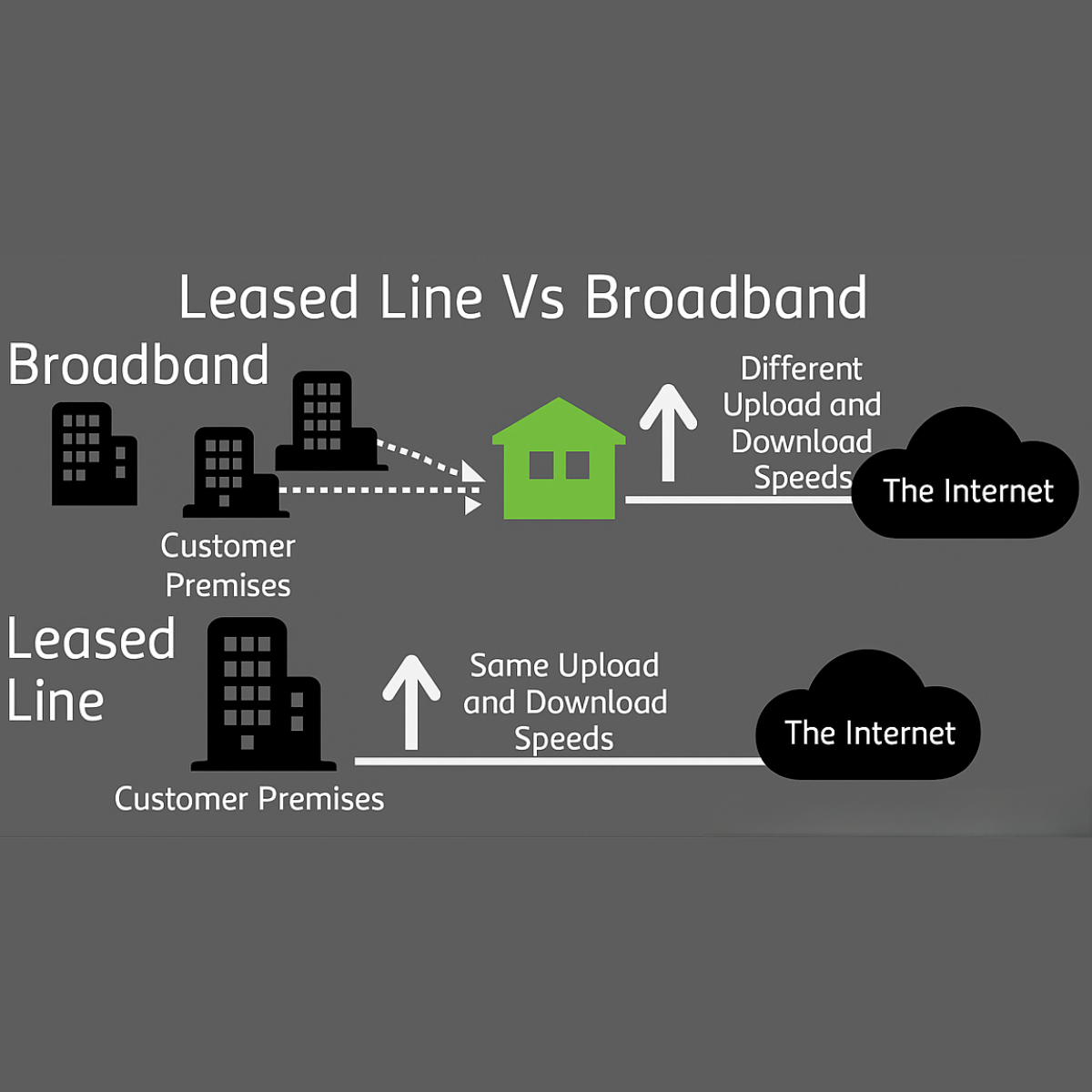
Business broadband is a commercial internet service that usually runs over shared infrastructure. It is affordable, widely available, and suitable for many small offices, shops, and branch sites.
A leased line is a dedicated internet connection used only by your business. It costs more, but gives you guaranteed speeds, stronger uptime commitments, and better support for business-critical services.
| Feature | Business Broadband | Leased Line |
| Connection type | Shared | Dedicated |
| Typical monthly cost | £30–£150 | £200–£700+ |
| Speed profile | Often faster download than upload | Symmetrical upload and download |
| Performance | Can vary at peak times | Consistent and uncontended |
| Fault repair | Often best-effort | Usually guaranteed fix times |
| Best for | Small teams, retail, light cloud use | VoIP-heavy, cloud-heavy or critical sites |
| Installation | Often 2–4 weeks | Often 30–90 working days |
The best option depends on risk. If downtime is inconvenient, business broadband may be fine. If downtime causes lost revenue, a leased line is often worth the extra cost.
You may also find our guide to leased line costs in the UK useful when comparing pricing and installation considerations.
Shared Connection vs Dedicated Connection
Here’s the real difference: business broadband is usually shared, while a leased line is dedicated.
With business broadband, your connection shares local network capacity with other users. That can include nearby companies and residential users. At quiet times, performance may feel excellent. During busy periods, speeds can drop.
A leased line gives your business dedicated bandwidth. If you buy a 500Mbps leased line, that capacity is reserved for you. You are not competing with other users in the area.
This matters when your business relies on:
- Cloud-based systems
- Video conferencing
- VoIP phone systems
- Large file transfers
- Remote desktop access
- Online payment systems
- Customer-facing applications
For light use, shared infrastructure is usually acceptable. For critical operations, dedicated access gives more control and predictability.
Performance Differences That Matter
Headline speed can be misleading. A 1Gbps broadband service may look better than a 500Mbps leased line, but the real experience can be very different.
Upload speed
Business broadband often provides higher download speeds than upload speeds. This works well for browsing, email, and streaming information from the internet.
But many businesses now need strong upload performance too. Upload speed matters when you:
- Send large files
- Back up data to the cloud
- Run video meetings
- Use VoIP calls
- Sync data between systems
- Support remote workers
A leased line usually provides symmetrical speeds. That means upload and download speeds are the same.
To understand how cloud communications affect connectivity requirements, read our guide on building a reliable business communication system with VoIP and broadband.
Peak-time contention
Business broadband can slow during peak hours because it shares capacity with other users. This is called contention.
A leased line avoids this issue because it is uncontended. Your bandwidth is reserved for your business, so performance stays more stable throughout the day.
Latency and jitter
Latency is the delay when data travels between your systems and the internet. Jitter is the variation in that delay.
For VoIP, video calls, and remote desktop tools, low latency matters.
High latency or jitter can cause:
- Robotic call audio
- Delays during conversations
- Frozen video meetings
- Dropped VoIP calls
- Poor remote desktop performance
A leased line usually offers lower latency and more stable jitter than standard business broadband.
If your team already struggles with connectivity issues, our article on why business internet becomes slow explains the most common causes and fixes.
Realistic Cost Ranges In 2026
Cost is one of the main reasons businesses hesitate to choose a leased line.
Typical UK business broadband costs are:
- £30–£60 per month for basic FTTC or entry-level services
- £60–£150 per month for faster FTTP or premium business packages
- More if you add managed routers, static IP addresses, security, or 4G/5G backup
Typical leased line costs are:
- £200–£350 per month for lower bandwidth in well-connected areas
- £350–£700+ per month for higher speeds or harder-to-serve locations
- More if the site needs new fibre, civils work, or complex installation (or high capacity such as 10Gb)
You can also compare broader pricing considerations in our guide to business broadband costs explained.
A leased line may also involve longer contracts and installation charges. However, the monthly price alone does not show the full value.
Ask this before choosing:
What would one hour of internet downtime cost us?
Include staff time, lost sales, missed calls, delayed work, and customer impact.
When Business Broadband Is The Right Fit
Business broadband is often the right choice when your needs are simple and cost control is important.
It may suit your business if:
- You have a small team
- You mainly use email, web browsing, and basic cloud apps
- You only have a few VoIP calls at once
- Occasional slowdowns would not stop work completely
- You do not host critical systems on site
- You have a backup connection for emergencies
- You need a quick installation
For many small businesses, retail sites, and satellite offices, business broadband offers good value.
When A Leased Line Is The Right Fit
A leased line becomes the better option when internet access is central to how your business operates.
Consider a leased line if:
- Your team relies heavily on cloud systems
- You use VoIP phone systems throughout the day
- You run frequent video conferencing
- You upload or download large files
- You need stable performance during business hours
- You cannot wait days for fault repair
- Downtime causes lost revenue
- You need guaranteed uptime
- You need symmetrical upload and download speeds
If your business relies heavily on cloud telephony, our VoIP telephone systems page explains how connectivity quality directly affects call performance.
Main Disadvantages Of A Leased Line
A leased line is powerful, but it is not perfect.
The main disadvantages are:
- Higher monthly cost
- Longer installation
- Possible civils work
- Longer contracts
- Overkill for light users
- Still needs failover planning
Does A Business Need Business Broadband?
Yes, most businesses should use business broadband rather than home broadband.
Business broadband often gives you:
- Better support options
- Business-grade routers
- Static IP address availability
- More suitable terms of use
- Improved repair options
- Add-ons such as security or backup connectivity
For more guidance on fibre infrastructure, see our article on what FTTP broadband is.
Failover: Why One Connection Is Not Enough
Whether you choose business broadband or a leased line, you should think about resilience.
A single line can fail. A digger can cut fibre. A router can break. A local outage can affect your area.
For critical sites, use failover.
Common options include:
- Business broadband as backup to a leased line
- 4G or 5G backup for essential services
- Two fixed lines from different providers
- A dual-WAN router that switches automatically
You should also test failover regularly.
Ofcom also provides useful guidance on business broadband and telecom services in the UK.
Next Steps: How To Choose With Confidence
Before signing a new contract, complete a short connectivity review.
Check:
- Current provider and contract end date
- Current download and upload speeds
- Number of users
- Number of concurrent VoIP calls
- Video conferencing usage
- Cloud systems used daily
- Downtime history
- Estimated cost of one hour offline
- Growth plans for the next 12–24 months
- Whether you already have failover
Then request at least three quotes. Ask each provider to show:
- Monthly rental
- Installation cost
- Contract length
- Guaranteed speeds
- Guaranteed fix times
- Uptime commitments
- Router or firewall costs
- Backup options
- Any excess construction charges
Final Recommendation
Business broadband is the right choice for many small businesses that need affordable, practical connectivity. It works well for email, web browsing, light cloud use, and smaller teams.
A leased line is the better choice when your business needs guaranteed performance, stable uploads, low latency, strong service levels, and faster repair times.
For many UK businesses in 2026, the strongest setup is both: a leased line for the main connection and business broadband or 4G/5G as failover.
If you are unsure which option is right, Digital Exchange Group can help you assess your current connection, calculate downtime risk, and compare provider options.
Contact Digital Exchange
Digital Exchange helps businesses across the UK improve connectivity, reduce downtime risk, and build more reliable communications infrastructure.
Whether you need business broadband, leased lines, VoIP systems, or resilient backup connectivity, our team can help you compare providers and choose the right solution for your business requirements.
You can also request pricing or contact Digital Exchange to discuss your current setup.
Ready to review your business connectivity? Contact Digital Exchange today to compare broadband, leased line, and failover options for your business.