
If you are budgeting for better connectivity this year, the first thing to know is simple: Leased Line pricing in 2026 still varies more by postcode than by provider. In most parts of the UK, a 100Mb Leased Line will often land between £150 and £400 per month, a 1Gb Leased Line will usually sit around £300 and £900+ per month, and a 10Gb service can range from £1,000 to £3,500+ per month.
That is a wide-spread, and there is a reason for it. The final price depends on where your building is, how far it is from a provider network, how difficult the installation is, and how long you are willing to sign for.
This guide explains what a Leased Line is, what drives cost, what installation really involves, and how UK businesses should compare quotes in 2026. If you are an IT manager, operations lead, finance director, or business owner, this will help you buy with more confidence and fewer surprises.
If you are comparing wider connectivity solutions for your company, you may also find our guide to Sheffield business broadband services useful.
Quick answer
Here is the short version for 2026 UK pricing:
- 100Mb Leased Line: typically £150 to £400 per month
- 500Mb Leased Line: typically £250 to £650 per month
- 1Gb Leased Line: typically £300 to £900+ per month
- 10Gb Leased Line: typically £1,000 to £3,500+ per month
A few points matter straight away:
- Postcode is the biggest pricing driver
- Urban sites usually get better prices than rural sites
- Installation may be free, partly subsidised, or charged separately
- Some quotes hide civil works risk until the survey stage
- Longer contracts often reduce the monthly rental
What is a Leased Line?
A Leased Line is a dedicated internet connection delivered to your premises with symmetrical upload and download speeds and a business-grade SLA.
Unlike standard business broadband, a Leased Line is not shared with neighbouring premises. That means you get fixed bandwidth, more predictable performance, and stronger uptime commitments. For businesses that rely on cloud services, large data transfers, VoIP systems, hosted applications, and video calls, that matters a great deal.
If your business also relies on cloud calling, read our guide to VoIP telephone systems to understand how connectivity and communications work together.
The key benefits are usually:
- Dedicated, uncontended performance
- Symmetrical speeds
- Better fault response times
- Higher service availability
- Support for critical business applications
Leased Line vs business broadband and FTTP
A lot of buyers compare Leased Lines with FTTP or standard business broadband, so it helps to separate them clearly.
Standard business broadband
Business broadband is usually cheaper, but it is still a shared service. Speeds can dip at busy times, and the SLA is often lighter (or non-existent). It is suitable for many offices, but not always enough for firms that need guaranteed performance.
To understand the wider pricing picture, see our guide on business broadband costs explained.
FTTP
FTTP is far stronger than older broadband services and can offer very fast speeds. Still, it is not the same as a Leased Line. FTTP is normally a contended service, even when performance is excellent.
You can learn more in our guide to FTTP broadband.
Leased Line
A Leased Line is best when you need consistency. If call quality, uptime, VPN performance, cloud access, or multi-site connectivity are business-critical, the extra cost can be justified.
For a more detailed comparison, read broadband vs Leased Line.
Dedicated Internet Access explained
You may also see the term Dedicated Internet Access, or DIA.
In simple terms, DIA is internet access delivered over a dedicated connection, with no contention and committed performance. In practice, many UK providers use DIA and Leased Line almost interchangeably for Ethernet services.
Typical DIA use cases include:
- Multi-site organisations
- Heavy cloud usage
- Hosted telephony
- Video conferencing at scale
- Large file transfer
- Businesses with strict uptime requirements
Typical Leased Line prices in 2026
The numbers below are useful for budgeting, but they are not a substitute for a postcode-specific quote.
| Speed tier | Typical monthly range | Notes |
| 100Mb | £150 – £400 | Common entry point for SMEs |
| 500Mb | £250 – £650 | Good fit for growing teams and cloud workloads |
| 1Gb | £300 – £900+ | Popular for larger sites and heavier usage |
| 10Gb | £1,000 – £3,500+ | Enterprise-grade connectivity with highly variable pricing |
Urban vs rural pricing
In major cities, pricing is usually lower because the fibre coverage is denser and there is more competition. In rural areas, prices rise because installation is harder and network reach is thinner.
- City centre or on-net locations: lowest monthly rental
- Business parks with nearby fibre: mid-range pricing
- Rural or hard-to-reach sites: highest pricing, with more ECC risk
Bearer vs bandwidth: what it means
This is one of the most common points of confusion in Leased Line quotes.
Bearer
The bearer is the physical capacity of the circuit. Think of it as the size of the pipe installed to your site.
Bandwidth
The bandwidth is the speed you actually buy and use over that bearer.
For example, a provider may install a 1Gb bearer but only bill you initially for 100Mb bandwidth. That can be useful because you may be able to upgrade speeds later without a fresh install.
What affects Leased Line costs?
Leased Line costs are shaped by a small number of major factors.
- Postcode and business location
This is usually the biggest factor. Two offices ten miles apart can receive very different quotes.
- Distance to PoP
The distance to the nearest Point of Presence (PoP) has a major impact on installation cost.
- Installation complexity
If the route to your building is simple and there is existing duct space, costs stay lower. If additional civil engineering work is required, costs can rise significantly.
- SLA level
A stronger SLA usually means a higher monthly price, but it also reduces operational risk.
If uptime matters to your business, our article on the cost of downtime explains why resilient connectivity matters.
- Provider network ownership
Providers with stronger local fibre reach may quote more competitively where your building is already close to their network.
- Contract length
Longer contracts usually reduce monthly rental because setup costs are spread across more months.
Leased Line installation costs
The monthly rental is only one part of the total cost.
Typical one-off installation items include:
- Survey and planning
- Activation
- Fibre build
- Internal cabling
- Router and firewall hardware and setup
- Project management
- Civil works where needed
Some providers waive installation charges on longer terms. Others quote lower monthly pricing and recover costs through upfront fees.
Excess Construction Charges (ECCs)
ECCs are one of the biggest variables in Leased Line procurement.
These charges can apply if additional engineering work is required to deliver service, including:
- New ducting
- Trenching
- Road crossings
- Traffic management
- Wayleave-related work
- Non-standard building entry
ECCs can add hundreds or thousands of pounds to a project, so always ask providers to confirm whether they are included, capped, or still subject to survey.
Site survey: why it matters
A proper site survey is essential before signing a multi-year contract.
The survey helps confirm:
- Route feasibility
- Distance to network PoP
- Internal cabling requirements
- Duct availability
- ECC exposure
- Wayleave risk
Installation timelines and delays
Typical installation timelines are:
- Simple installs: 30 to 60 working days
- Standard installs: 60 to 90 working days
- Complex installs: 90 to 120 working days or more
The most common causes of delay include:
- Wayleave agreements
- Road permits
- Civil engineering work
- Building access issues
- Third-party permissions
Major Leased Line providers in the UK
The UK market includes infrastructure owners, national carriers, and specialist resellers. Comparing several providers is usually the best approach and that is how we do things.
Examples include:
- BT
- Virgin Media Business
- CityFibre
- TalkTalk Business
- Specialist resellers and managed service providers
For independent guidance on broadband and telecom services, Ofcom also provides useful information on business broadband and telecoms.
Leased Line vs alternatives
Leased Line vs FTTP
FTTP can deliver strong speeds at a lower price, but it remains a shared service.
Leased Line vs standard business broadband
Standard business broadband is cheaper but less predictable.
Leased Line vs 5G backup
5G is not usually a replacement for a primary Leased Line in business-critical environments. It is better used as a failover or backup solution.
How to get better Leased Line quotes
A smart buying process can save a lot of money.
Ask for at least three quotes
Pricing can vary widely, even for the same address.
Request itemised pricing
Ask providers to separate:
- Monthly rental
- Installation charges
- ECCs
- Managed router costs
- Static IP fees
- Support add-ons
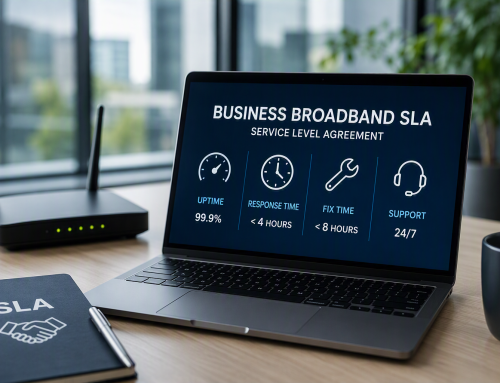
Get SLA details in writing
Ask for:
- Uptime targets
- Fix-time targets
- Service credits
- Support hours
How to secure the best deal
If you want the strongest commercial outcome:
- Compare on-net and off-net providers
- Negotiate installation charges
- Bundle broadband, VoIP, or mobile services
- Review support and SLA quality carefully
If your business relies on hosted calling and cloud systems, it may help to read our guide on building a reliable business communication system.
FAQs
How much does a Leased Line cost in the UK?
In 2026, a 100Mb Leased Line often starts around £150 per month and may rise to £400 or more. Final pricing depends mainly on postcode, network reach, and installation complexity.
Why is a Leased Line expensive?
A Leased Line is more expensive because it is a dedicated service with guaranteed bandwidth, symmetrical speeds, stronger SLAs, and potentially significant installation costs.
Is a Leased Line worth it?
For many businesses, yes. If downtime is costly or your business relies heavily on cloud systems, remote working, VoIP, or hosted platforms, the additional reliability can justify the higher price.
Can I upgrade speed mid-contract?
Often yes, especially if the provider installed a higher-capacity bearer initially. Always check the contract terms for upgrade rules and pricing.
Final recommendations
If you remember only two things from this guide, make them these:
- Start with postcode-specific comparison quotes
- Do not commit before survey findings are confirmed
Leased Line pricing in the UK is too location-sensitive for generic list prices to be fully reliable. A strong deal depends on the exact building, route to network, contract term, and provider flexibility.
If you want help comparing quotes, checking ECC exposure, or deciding whether a Leased Line is the right fit compared with FTTP or business broadband, Digital Exchange can help.
Book a consultation with Digital Exchange
Need a clearer answer on Leased Line pricing for your site?
Digital Exchange helps UK businesses compare Leased Line options, reduce connectivity downtime, and build scalable communication systems that support cloud applications, hosted telephony, and long-term growth.
If you are based in South Yorkshire, start with our Sheffield business broadband services. If your connectivity project also supports cloud calling, our VoIP telephone systems service can help you create a more reliable communications setup.
You can also request pricing from Digital Exchange or contact our team for tailored guidance.
Ready to compare Leased Line options for your business? Book in a Free Consultation that suits your diary today for postcode-level pricing guidance, provider comparison support, and practical advice on installation risks and contract terms.