Choosing business broadband should be straightforward, but the terminology can make it feel more complicated than it needs to be. Providers may recommend Ethernet First Mile, FTTP or a fibre leased line without clearly explaining why one service costs more, what the practical differences are or whether the extra performance will benefit your organisation.
The honest answer is that there is no single best connection for every business. FTTP is often the most cost-effective option for a small office using cloud applications. A leased line can be worth the higher price when downtime or inconsistent performance would directly affect revenue. EFM may still be useful at some premises where full fibre is unavailable, but it is a copper-based technology with less room for future growth.
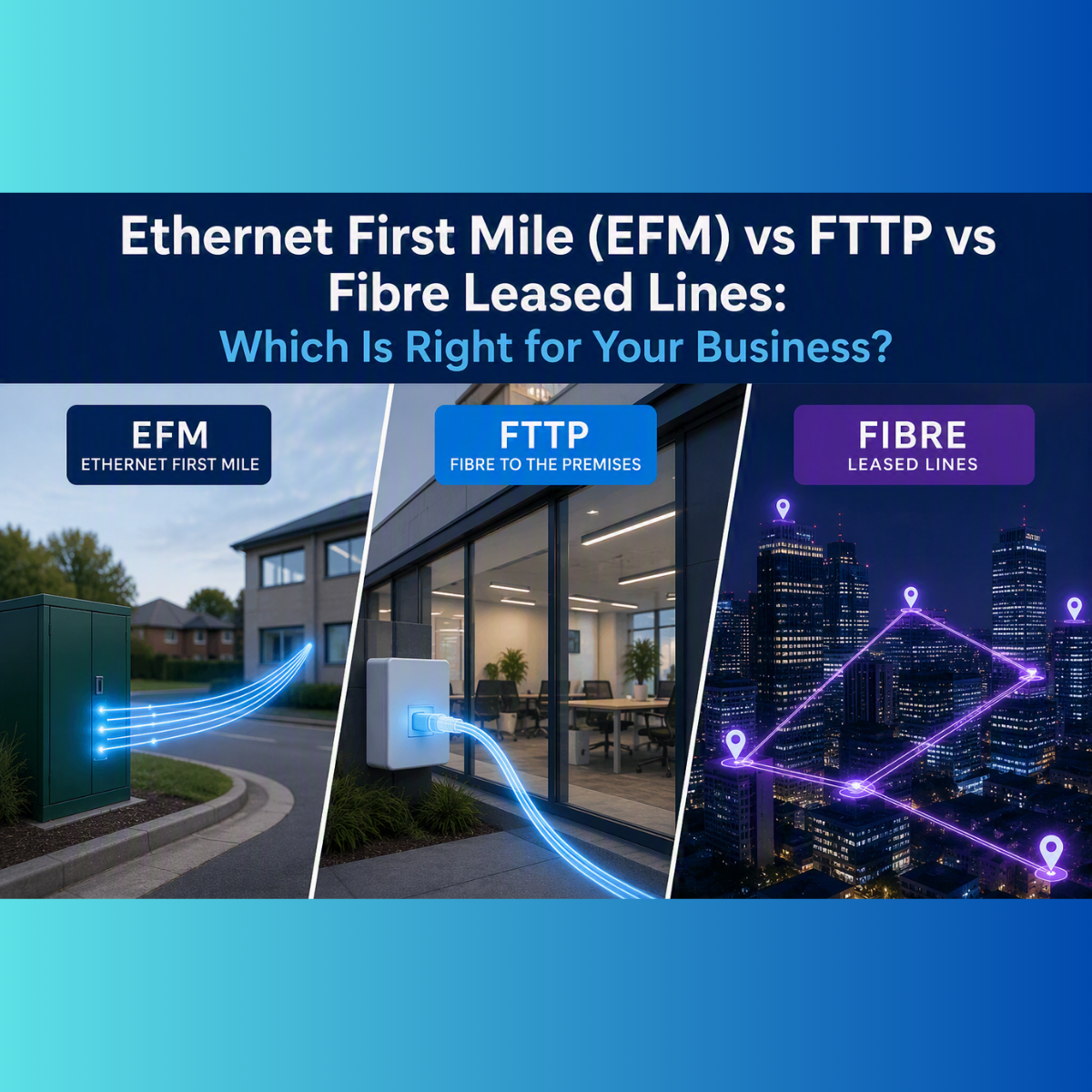
This guide compares all three options in plain English. It covers speed, uploads, contention, reliability, installation, service levels and cost so you can shortlist the connection that fits your present workload and future plans.
What Is Ethernet First Mile?
Ethernet First Mile, usually shortened to EFM, is a dedicated Ethernet service delivered over multiple copper pairs. The pairs are bonded together to create one connection with matching upload and download speeds. Unlike ordinary broadband, the service is designed for business use and can include stronger fault-management commitments.
How EFM works
The provider combines several copper circuits between the premises and the local exchange. If one pair develops a fault, the remaining pairs may continue carrying traffic at a reduced capacity while the problem is investigated. That built-in resilience helped make EFM attractive before full fibre became widely available.
The limitation is the copper itself. Performance reduces with distance, and the maximum speed is modest compared with current FTTP and leased-line services. EFM can still support email, hosted applications, smaller VoIP deployments and general office work, but it offers limited headroom for data-heavy businesses or rapid workforce growth.
When EFM may still make sense
- Full fibre is not currently available at the premises.
- The business needs symmetrical uploads and downloads but has moderate bandwidth requirements.
- A dedicated connection is preferred and the quoted EFM installation is practical.
- The service is being used as an interim option while a fibre solution is planned.
Before committing, ask the provider how long the service will remain supported locally and what the migration route will be. Ofcom and the wider telecoms industry are supporting a long-term transition away from copper networks, so an EFM proposal should include a realistic future upgrade plan.
What Is FTTP Business Broadband?
FTTP means Fibre to the Premises. Fibre-optic cable runs all the way to the building rather than stopping at a roadside cabinet and relying on copper for the final section. Ofcom’s terminology guidance reserves the term full fibre for this end-to-end fibre connection. Digital Exchange explains the technology in more detail in its guide to what FTTP is.
Why FTTP suits many SMEs
FTTP can provide much higher speeds than copper-based broadband, often with enough capacity for cloud services, Microsoft Teams, hosted VoIP, online backups and dozens of connected devices. It is also generally more reliable than copper because fibre is less vulnerable to electrical interference and weather-related degradation.
The main compromise is that standard FTTP is normally a shared service. Capacity within the wider access network is used by multiple customers, and the package may offer significantly faster downloads than uploads. That does not make FTTP unsuitable for business, but it means buyers should look beyond the headline download figure.
An office may be offered gigabit download speeds but still experience performance issues if its upload capacity is too low for simultaneous video calls, off-site backups and cloud file transfers. That’s why it’s important to assess the overall service rather than focusing purely on headline speeds. Before choosing a provider, it’s also worth checking which broadband technologies are available at your premises using the Ofcom Mobile and Broadband Checker. Combined with our guide to business broadband costs, this will help you compare availability, performance, support and long-term value before making a decision.
What Is a Fibre Leased Line?
A fibre leased line is a dedicated connection between your premises and the provider’s network. The bandwidth is reserved for your organisation rather than shared with neighbouring users, so the service is described as uncontended. Upload and download speeds are symmetrical, and the circuit is usually monitored and supported under a formal service level agreement.
Why leased lines cost more
You are not simply paying for a faster version of broadband. The price reflects dedicated capacity, a business-grade support structure, agreed performance targets and, where necessary, construction work to bring the circuit into the premises. Installation can therefore take longer than activating an available FTTP service.
A leased line is most valuable when connectivity has a measurable operational cost. Examples include contact centres, manufacturers, busy professional-services firms, multi-site organisations and companies running cloud-based systems that staff cannot work without. See our guides to leased line costs in the UK and business broadband versus leased lines for a closer look at commercial considerations.
EFM vs FTTP vs Fibre Leased Lines: Direct Comparison
| Factor | EFM | FTTP | Fibre leased line |
| Network | Bonded copper pairs | Full fibre, usually shared access | Dedicated fibre circuit |
| Uploads and downloads | Symmetrical | Often asymmetrical | Symmetrical |
| Typical capacity | Lower and distance-dependent | High, package-dependent | High and scalable |
| Contention | Dedicated access service | Usually contended | Uncontended |
| Service levels | Business-grade, contract-specific | Provider and package-specific | Premium SLA, contract-specific |
| Installation | May be quicker where copper pairs exist | Often quick when the premises is ready | Longer where survey or construction is needed |
| Best fit | Fibre-not-available locations with modest needs | Most small and growing businesses | Mission-critical and data-heavy operations |
| Future scalability | Limited | Good | Excellent |
The table shows why speed alone is a poor buying criterion. FTTP may advertise a higher headline download speed than an entry-level leased line, but the leased line can still deliver a more consistent business experience because its bandwidth is dedicated and symmetrical. Equally, a company should not pay for a leased line purely for prestige when a well-specified FTTP package would comfortably handle its workload.
Which Connection Is Best for Your Business?
Choose EFM when fibre is unavailable
EFM can be a practical fallback when a site cannot yet obtain full fibre and needs more dependable, symmetrical connectivity than standard copper broadband. Treat it as a solution to a specific availability problem and confirm how the provider will support migration later.
Choose FTTP for strong value and everyday growth
FTTP is usually the best-value choice for a small or medium-sized office using cloud applications, online accounting, video calls and hosted telephony. It can also suit retail, hospitality and professional-services sites where good performance matters but a premium SLA is not essential. Businesses in the region can explore Sheffield business broadband options and availability through Digital Exchange.
Choose a fibre leased line when downtime is expensive
A leased line becomes easier to justify when a connection failure would stop staff working, interrupt customer service, delay production or prevent access to critical platforms. It is also appropriate when large uploads, off-site replication, hosted systems or many concurrent calls require guaranteed symmetrical capacity.
The decision should be based on risk as well as usage. Estimate what one hour without internet would cost in lost productivity and revenue, then compare that figure with the additional monthly price of a stronger service and backup connectivity.
Questions to Ask Before Signing a Contract
Before comparing quotations, confirm which broadband technologies are available at each of your business locations. While providers can carry out availability checks, the Ofcom Mobile and Broadband Checker is an excellent independent resource for checking the broadband services currently available at your premises. This helps ensure you’re comparing realistic options before making an investment.
- What download and upload speeds are guaranteed or estimated?
- Is the connection shared or uncontended?
- What does the SLA actually guarantee, and what compensation applies?
- What is the target fault response and restoration time?
- Could excess construction charges apply after the survey?
- How long is the expected installation period?
- Can bandwidth be upgraded without replacing the circuit?
- What backup connection is recommended if the main service fails?
Frequently Asked Questions
Is EFM being phased out?
Copper-based services are becoming less central as full-fibre coverage expands and the industry prepares for copper retirement. Availability and withdrawal plans vary, so businesses should confirm the position for their exchange and include a migration route in any new EFM agreement.
Is FTTP the same as a leased line?
No. Both can use fibre all the way to the premises, but standard FTTP is normally shared and may be asymmetrical. A leased line reserves dedicated bandwidth for one organisation and usually includes stronger service commitments.
Which option is best for VoIP?
All three can carry VoIP when properly specified. FTTP is suitable for many SMEs, while leased lines provide greater predictability for contact centres or sites with many concurrent calls. EFM can support smaller deployments where its available bandwidth is sufficient.
Do we need a leased line for hybrid working?
Not necessarily. A business with cloud-based systems and moderate usage may run hybrid working effectively over FTTP. A leased line becomes more relevant when many employees depend on remote access, large file transfers or always-on cloud platforms.
Speak to Digital Exchange
EFM, FTTP and fibre leased lines each solve a different connectivity problem. For most SMEs with full fibre available, FTTP offers an effective balance of speed and cost. EFM can still fill an availability gap, while a leased line provides the strongest performance and support for operations that cannot tolerate uncertainty.
Digital Exchange can check availability at your premises, compare suitable services and explain the trade-offs before you commit. Request business broadband pricing or contact Digital Exchange to discuss your current usage, future plans and resilience requirements.