Your broadband fails on a Monday morning. Cloud systems stop responding, VoIP calls are affected and staff cannot work normally. The important question is not simply whether your provider will fix it, but what they have contractually promised to do, how quickly they will act and what happens if they miss that commitment.
That is where a Service Level Agreement (SLA) matters. This guide explains what an SLA can cover, where businesses often misunderstand the wording, and what to check before signing a broadband contract. The aim is not to tell every business to buy the strongest SLA available. It is to help you pay for the level of protection your business actually needs.
What Is A Business Broadband SLA?
A business broadband SLA sets out measurable service commitments associated with your connectivity contract. Ofcom describes an SLA as a contractual commitment from a telecoms provider to deliver a minimum level of service quality, such as a quicker repair. The related service level guarantee (SLG) can set out the redress available when an agreed service level is missed.
This distinction matters. A sales page might say a service is “reliable” or has “priority support”, but those phrases mean little unless the contract explains what is measured, the target, any exclusions and the remedy if the provider misses it.
Ofcom also requires providers to publish information about SLAs and SLGs in their standard SME contracts and provide that information in a durable medium when an SME enters a contract. Ofcom explains these protections for business customers.
What Should A Business Broadband SLA Actually Cover?
There is no single SLA specification that is right for every broadband product. A small office using email and web applications has different requirements from a company whose phones, payment systems and customer platforms all depend on one connection. However, there are several areas worth checking.
Fault Response Time
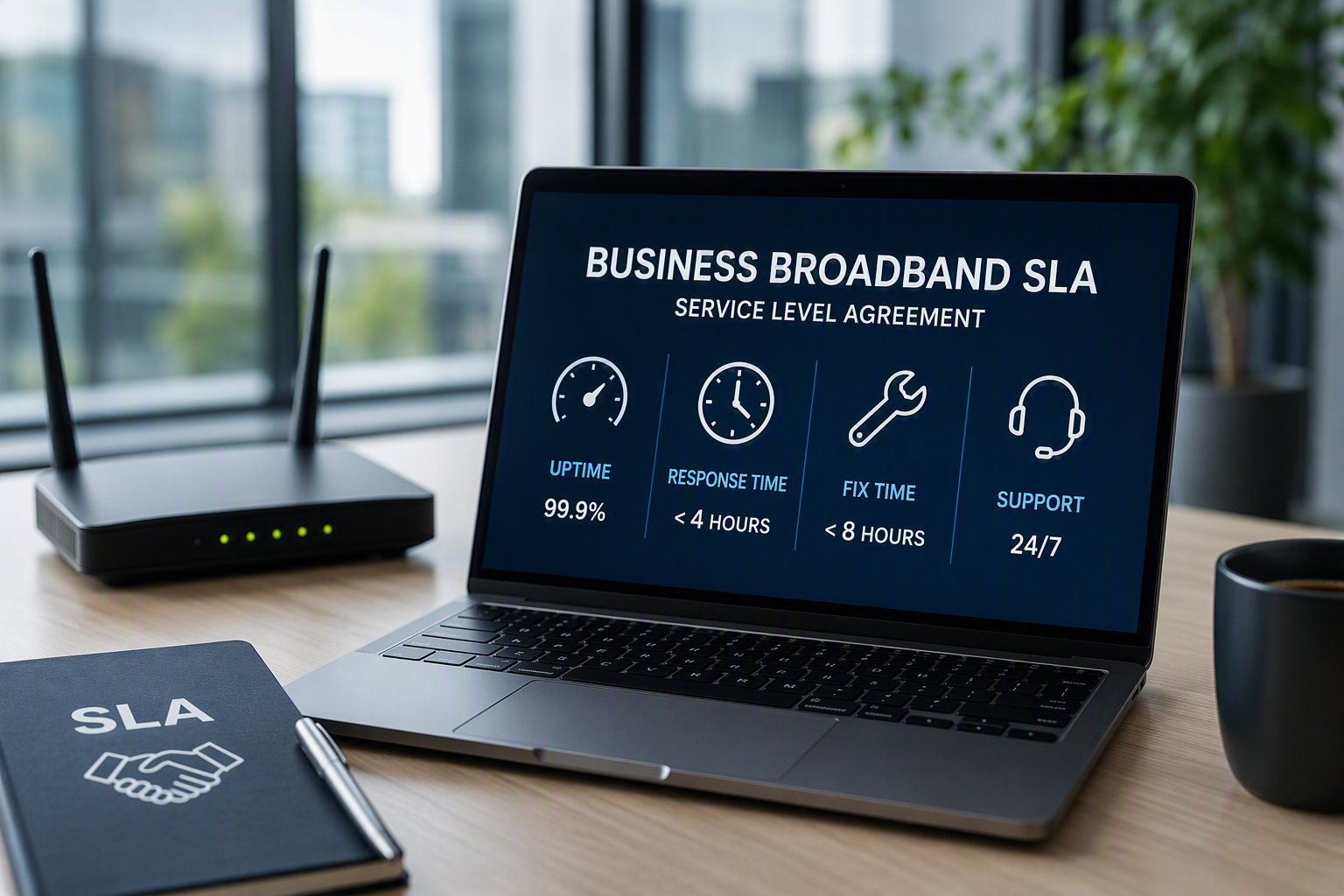
Response time is normally about how quickly the provider acknowledges, diagnoses or starts dealing with a reported fault. It is not necessarily the time by which your service will be restored. Ask exactly when the clock starts and whether the target applies 24/7 or only during defined support hours.
Repair Or Restore Target
This is usually more important than acknowledgement time. Look for the target to restore service after a qualifying fault is reported. Do not assume that a phrase such as “four-hour SLA” always means your connection will definitely be repaired within four hours. The wording can refer to different commitments depending on the product, and exclusions may apply.
If fast recovery is commercially important, compare the repair commitment alongside the connection itself. Our business broadband vs leased line guide explains why the two services should not be compared on headline speed alone.
Availability And Uptime
Some services include an availability target, often expressed as a percentage. If a provider quotes one, check the measurement period and what is excluded. Planned maintenance, customer equipment, power failures at your premises or events outside the provider’s control may not count in the calculation.
Also avoid treating 99.9% and 99.99% as interchangeable. Over a full 365-day year, 99.9% availability equates to about 8 hours 46 minutes of potential unavailability, while 99.99% equates to about 53 minutes. Those figures illustrate the maths, but the contractual measurement method is what ultimately matters.
Service Credits Or Other Redress
An SLA should make it clear what happens when an applicable target is missed. This may be a service credit rather than compensation for the wider commercial losses caused by an outage. Check how the credit is calculated, whether you must claim it, the deadline for doing so and whether there is a cap.
Do not assume Ofcom’s residential automatic compensation scheme applies to a dedicated business service. The scheme is aimed at residential fixed-line and broadband services and specifically excludes dedicated services intended primarily for business customers. Your business contract therefore matters.
Performance Commitments
For some connectivity products, availability is only part of the story. Businesses using voice, video, hosted applications or large cloud transfers may also care about bandwidth, latency, jitter and packet loss. If a supplier presents these as guaranteed characteristics, make sure the contract defines how and where they are measured.
If call quality is the main concern, it is also worth reviewing what causes dropped VoIP calls, because broadband faults are only one possible cause.
Escalation And Support Hours
A useful SLA should make the fault process understandable. Who do you contact? Is support available outside normal office hours? When is a fault escalated? Will you receive updates during a major incident? For an internet-dependent business, knowing the escalation route before an outage is far better than discovering it while staff are offline.
Business Broadband SLA Vs Leased Line SLA
One of the biggest mistakes is assuming every “business broadband” product carries the same protection. It does not. Service levels vary by provider, access technology and package.
Standard FTTP can provide excellent speeds and may be entirely appropriate for an SME, but the repair commitment may still be less demanding than a dedicated Ethernet or leased-line service. A leased line is typically purchased for dedicated, symmetrical connectivity and stronger service commitments, but you should still read the individual SLA rather than assuming every leased line includes the same repair time or availability figure.
The commercial trade-off is straightforward: stronger service levels and dedicated connectivity usually cost more. Our leased line costs guide covers the pricing factors to consider before deciding whether that additional protection is justified.
Do You Actually Need A Stronger SLA?
Not necessarily. If a short outage would be inconvenient rather than damaging, paying substantially more for the strongest available SLA may be poor value. A small office may be better served by good-quality FTTP plus a sensible backup connection.
On the other hand, if an outage stops revenue, customer calls, cloud systems or card payments, the cost of resilience should be compared with the cost of being offline. An SLA is also not a substitute for resilience: it tells you what happens after a failure; it does not prevent one.
That is why businesses with a low tolerance for downtime should consider a secondary connection or mobile backup as well as repair targets. See our guide to business broadband failover for the difference between faster repair and continuity during an outage.
How To Audit An SLA Before Signing
Read the SLA alongside the main contract rather than in isolation. A strong headline can become much less impressive once definitions and exclusions are considered.
1. Ask What The Clock Measures
Does the target measure acknowledgement, engineer attendance, restoration or permanent repair? These are different things. Ask the provider to explain a real example from the moment you report a fault to the point at which service is restored.
2. Check The Support Window
A four-hour target operating only during defined service hours is different from a genuine 24/7 commitment. Match the support window to when your organisation actually trades.
3. Read Every Exclusion
Check scheduled maintenance, customer equipment, internal cabling, power, access problems and force majeure wording. Also establish who is responsible for the router or firewall. A connection SLA cannot protect you from every failure inside your own premises.
4. Calculate The Real Redress
Ask for a worked example of the service credit for a missed repair target. A credit against monthly rental may be useful, but it may be far smaller than your business loss. This is why resilience planning matters as much as contractual redress.
5. Compare The SLA With The Price
Do not automatically buy the highest specification. Compare the extra monthly cost with your realistic cost of downtime and the alternatives. The business internet contract checklist gives you additional questions to ask before committing.
What About Broadband Speed Guarantees?
A minimum speed commitment is not the same thing as a full-service SLA. Ofcom’s voluntary Business Broadband Speeds Code requires participating providers to give businesses speed information and, in qualifying circumstances, a right to exit if download speed remains below the minimum guaranteed level after the provider has had an opportunity to resolve the problem.
That protection is useful, but it should not be confused with a contractual promise to restore a complete loss of service within a particular number of hours. When comparing providers, ask about both speed commitments and fault-repair commitments.
You can read the Ofcom Business Broadband Code of Practice for more detail.
Business Broadband SLA Checklist
- What event counts as a fault?
- When does the response or repair clock start?
- Is support 24/7 or limited to business hours?
- What is the target for restoring service?
- Are uptime or performance metrics contractual?
- Which events are excluded?
- What service credit or redress applies if a target is missed?
- Do you need to submit a claim, and within what period?
- Who owns the escalation process?
- Would failover protect the business better than relying on repair time alone?
Speak To Digital Exchange
The right broadband service is not simply the one with the biggest speed number. It should reflect how dependent your business is on connectivity, how quickly you need faults restored and how much disruption you can tolerate.
Digital Exchange can help you compare business broadband, FTTP, leased lines and resilience options without treating every SME as though it has the same requirements. If you are reviewing a contract, start by identifying the applications that must stay online and the real cost of an outage.
If you would like to compare suitable options, request business connectivity pricing from Digital Exchange.